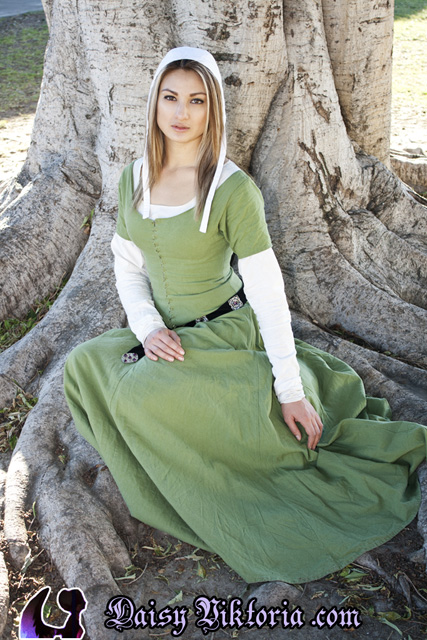
I made a 15th c. hat! This hood is present in many 15th century images, and I've wanted one for a while. I finally made it while watching a movie last night!
I came upon sevenstarwheel.wordpress.com in my search, and her pattern is very similar to mine. I just updated it and changed a few things! I also lined mine because I like the weight, and I like to sew everything by machine and then turn it inside out to hide the stitches. hehe
Note: This creates a fully lined hat. I started with two small rectangles for the brim and a large rectangle I folded in half for the back. I sewed the large rectangle together, cut off the top, then sewed the two brim pieces together with the back stuffed inside - so it turns right side out. The back of the brim is stitched together at the very bottom. To wear, wrap the two tails around the head and tie.
Showing posts with label 15th century. Show all posts
Friday, June 21, 2013
Thursday, June 20, 2013
14th/15th Century Pouch
I made this pouch to go with my favorite late 14th and early 15th century wardrobe. This is sort of a ubiquitous pouch style during this time, so it's appropriate for much of what I wear on a daily basis.
The first two images show examples of this pouch style in artwork and in an extant piece.
In the first of my own images, you can see my pouch in progress. The pouch itself is two rectangles, and the cord is finger loop braid. The eyelet holes are all hand stitched. Here, you can see how I did the tassels. I wrapped my yarn around a piece of cardboard and then took it off. I tied a piece of yarn around the center top to hold everything in place. Then I wrapped another piece of yarn around near the top to create the upper loop. Then I cut it off to my desired length and sewed all my tassels onto my pouch.
The first two images show examples of this pouch style in artwork and in an extant piece.
In the first of my own images, you can see my pouch in progress. The pouch itself is two rectangles, and the cord is finger loop braid. The eyelet holes are all hand stitched. Here, you can see how I did the tassels. I wrapped my yarn around a piece of cardboard and then took it off. I tied a piece of yarn around the center top to hold everything in place. Then I wrapped another piece of yarn around near the top to create the upper loop. Then I cut it off to my desired length and sewed all my tassels onto my pouch.
Thursday, May 30, 2013
15th Century German Under Dress
I made this dress for Mercy Neumark, who is a Master Potter! She does a lot of 15th-16th c. German pottery, so this was so perfect for her! The original image is late 15th c. German, and it depicts a female potter at a wheel. This would also be medieval underwear, to go underneath gowns. We chose wool lined in muslin so she could easily wear it alone (gotta look like the awesome picture!), while it can also be a warm undergarment. I also made the lacing cords for the sides by finger loop braiding, and the eyelets are all hand stitched. All machine stitching on the garment is hidden inside the lining and hand finished.
A note: This is one variation of the elusive under dress that has started to surface rapidly since the unveiling of the Lengberg bra. I personally believe that this type of fitted upper bodice and attached skirt could be one possibility regarding the origin of a Lengberg bra type garment. This one is obviously a bit different, but I think it's the same type of idea.
Tuesday, May 14, 2013
Sideless Surcote and Gothic Fitted Gown in Progress
I have several projects in progress right now. Since I have photos of these, I thought I'd share! These are both 14th/15th c. I have a couple of late 16th c. projects going too, but I need to photograph them before I can share!
The first one is a wool gothic fitted gown, lined in linen. I already had both fabrics at home, and I thought it would be nice for cold weather. It gets much colder in CA than where I grew up, so now I'm always bundling up in lots of layers that may or may not match, and this will really help!
The second one is a sideless surcote to accompany a late 15th century transition gown - also made, just not pictured. I used non-bias binding since I really only have evidence for non-bias and I wanted to try it out. I've worked with tons of bias binding in my life, and I was a bit worried about going around all these curves without bias, but it worked out really nicely! It's still pinned down on the backside in the photo, hence all those little pinned spots.
The first one is a wool gothic fitted gown, lined in linen. I already had both fabrics at home, and I thought it would be nice for cold weather. It gets much colder in CA than where I grew up, so now I'm always bundling up in lots of layers that may or may not match, and this will really help!
The second one is a sideless surcote to accompany a late 15th century transition gown - also made, just not pictured. I used non-bias binding since I really only have evidence for non-bias and I wanted to try it out. I've worked with tons of bias binding in my life, and I was a bit worried about going around all these curves without bias, but it worked out really nicely! It's still pinned down on the backside in the photo, hence all those little pinned spots.
Friday, May 3, 2013
Realm of Venus Showcase
I'm really honored to be this month's featured costumer on Realm of Venus! For anyone who doesn't know, Realm of Venus is a really cool website dedicated to Italian Renaissance costume research. They do periodical showcases for costumers who have created lovely Italian Renaissance outfits, and I'm really excited to be a part of it!
You can see the showcase here:
http://realmofvenus.renaissanceitaly.net/yourgarb/2013/DaisyV.htm
The gown I have featured is my 1490s Italian Renaissance dress made of red velvet and brocade, in the Venetian style. This is my favorite Italian Renaissance style! I included a few pictures below, but please check out the showcase (link above) for all of the photos and the information!
You can see the showcase here:
http://realmofvenus.renaissanceitaly.net/yourgarb/2013/DaisyV.htm
The gown I have featured is my 1490s Italian Renaissance dress made of red velvet and brocade, in the Venetian style. This is my favorite Italian Renaissance style! I included a few pictures below, but please check out the showcase (link above) for all of the photos and the information!
Thursday, April 11, 2013
My Old Green Kirtle
This is my old green kirtle, made in early 2007 to wear underneath my Burgundian over gown. This dress is a pretty ubiquitous 15th century style. I have newer and better kirtles now, but Jocelyne makes this one look so good, so I thought I'd share! She's also wearing my velvet belt and my linen coif, both of which were made sometime around 2011-2012.
http://www.faerie-queen.com/green-kirtle/
Labels:
15th century,
belt,
coif,
costume,
green,
historical,
kirtle,
linen,
medieval,
sca
Monday, April 8, 2013
Van Der Weyden / Memling Kirtle
This is a Netherlandish kirtle from the 15th century. Though the style is not exclusive to Rogier Van Der Weyden’s or Memling’s paintings, I used these sources as my primary inspiration. This kirtle has a waist seam and a separate skirt, and the front closes with lacing rings and handmade cord. This is my first waisted kirtle, and as much as I love it, I have to say I prefer the fit of the non-waisted kirtles. That said, I won't stop making these because they are also lovely!
The belt is made of velvet with metal filigrees.
The ruffled veil is linen. I hand stitched all the edges!
The sleeves pin on. They're made from a bit of brocade I had in my remnant stash.
This style was also worn under the famous Burgundian, or Netherlandish, gowns, in addition to being worn on its own. I intend to make a new Burgundian gown in the near future, and that was my excuse to make this dress too.
The last photos are me being silly, trying to pose like the women in the very dramatic scenes I stared at for hours when I made the dress.
You can see more photos here: http://www.faerie-queen.com/van-der-weyden-kirtle/
The belt is made of velvet with metal filigrees.
The ruffled veil is linen. I hand stitched all the edges!
The sleeves pin on. They're made from a bit of brocade I had in my remnant stash.
This style was also worn under the famous Burgundian, or Netherlandish, gowns, in addition to being worn on its own. I intend to make a new Burgundian gown in the near future, and that was my excuse to make this dress too.
The last photos are me being silly, trying to pose like the women in the very dramatic scenes I stared at for hours when I made the dress.
You can see more photos here: http://www.faerie-queen.com/van-der-weyden-kirtle/
Monday, April 1, 2013
1490s Italian Renaissance Dress
I love the Italian Renaissance, especially 1490s fashion, but I'm sad to say I haven't done much costuming from that era. Well, let me just fix that! I was particularly inspired by the Girl With Cherries painting by Ambrogio di Predis from c.1491-5. As per my usual methods, I was not interested in making a direct copy of the dress in the painting but rather using it as my primary inspiration, with supporting evidence from other various period sources and other similar dresses.
I purchased nothing new for this dress! It was meant to be a quick fun project to use up some of my materials on hand and give me a new dress I can wear on an everyday basis that's not another gothic fitted gown. The outer gown is made of rough dupioni silk and lined in hemp. The under gown is actually a false gown! It's just a bodice and sleeves. It's a clever solution to many layers when you live in a hot climate. The under gown is made of green cotton velveteen and lined in linen. I already had a camicia! All of the eyelet holes were done by hand. I grumble about all the time it takes, but really, I just do them while catching up on tv shows at night, so it's not such a big deal!
More images are here on my website: http://www.faerie-queen.com/silk-and-velvet-italian-renaissance-dress/
I purchased nothing new for this dress! It was meant to be a quick fun project to use up some of my materials on hand and give me a new dress I can wear on an everyday basis that's not another gothic fitted gown. The outer gown is made of rough dupioni silk and lined in hemp. The under gown is actually a false gown! It's just a bodice and sleeves. It's a clever solution to many layers when you live in a hot climate. The under gown is made of green cotton velveteen and lined in linen. I already had a camicia! All of the eyelet holes were done by hand. I grumble about all the time it takes, but really, I just do them while catching up on tv shows at night, so it's not such a big deal!
More images are here on my website: http://www.faerie-queen.com/silk-and-velvet-italian-renaissance-dress/
Saturday, March 30, 2013
Green and Brown Cotehardie
I made this cotehardie for my boyfriend. It's green and brown linen, fully lined. The fabric is all linen. The buttons and button holes are all done by hand. He's also wearing a coif and tights I made for him.
I have more images here: http://www.faerie-queen.com/early-15th-century-male-cotehardie/
Tuesday, March 26, 2013
Green and Purple-ish Cotehardie
In case it wasn't obvious by now, when it comes to SCA period, I LOVE late 14th-early 15th c. So I made another one! This is one of the cotehardies I'm most proud of. I made all the buttons by hand, and I also did all those millions of button holes by hand (fun!). This is patterned with gores in the sides and back. The gown is single layer linen because I live in southern California.
The veil I'm wearing is white linen. It's a pretty basic frilled veil style.
The belt is made of velvet with metal filigree bits I sewed on.
You can see more images here: http://www.faerie-queen.com/early-15th-century-cotehardie/
The veil I'm wearing is white linen. It's a pretty basic frilled veil style.
The belt is made of velvet with metal filigree bits I sewed on.
You can see more images here: http://www.faerie-queen.com/early-15th-century-cotehardie/
Wednesday, March 13, 2013
Medieval Morgan Le Fey
I finally posted these images! Months ago, last summer in fact, my barony did an Arthurian Legends themed event. I decided to be Morgan Le Fey. I've been dabbling in alchemy, well, since before I was in the SCA. I only just decided to make it one of my historical art forms last year. Anyway, my vials were all filled with useful concoctions I've made, as well as some dried herbs.
The gown is late 14th / early 15th c, depending on the specific region and person. The way I've styled it here, I feel it takes on more of a 14th c. vibe. It's a linen cotehardie / kirtle / gothic fitted gown with buttons all the way down the front and on the sleeves in counterchange. The sleeves pin on.
More picture here: http://www.faerie-queen.com/morgan-le-fey/
Tuesday, January 1, 2013
Mid-15th c. Flemish / Netherlandish Waisted Kirtle
My first waisted kirtle for the SCA! Of course, I have made a large number of modern waisted dresses with this type of fit before, but it's always monumental when it's a new historical style for me. ;)
This was based largely on Van der Weyden and Memling's paintings, mid-15th century Flemish / Netherlandish. This project actually began as an underlayer for a new "Burgundian" gown. However, it takes little time for a simple layer to turn into a whole complex project for me.
Nothing new was purchased to make this dress.
The kirtle is made from some linen I had lying around, which turns out to be linen/rayon blend. The sleeves are made from scraps of brocade I also had lying around. The belt is a scrap of velvet with filigrees and chain attached. I have a collection of filigrees, which was perfect! The veil is linen.
The front lacing loops are very small metal lacing rings, and the lacing cord is finger loop braided.
This is my second frilled veil, this one larger than the last. I'm not a very girly girl, but I really like the subtle "girly"ness of frilled veils, and I think I may make them my new "thing".
I also made a new underdress, but I can't fit it onto my incompressible mannequin, it's so incredibly fitted.
This was based largely on Van der Weyden and Memling's paintings, mid-15th century Flemish / Netherlandish. This project actually began as an underlayer for a new "Burgundian" gown. However, it takes little time for a simple layer to turn into a whole complex project for me.
Nothing new was purchased to make this dress.
The kirtle is made from some linen I had lying around, which turns out to be linen/rayon blend. The sleeves are made from scraps of brocade I also had lying around. The belt is a scrap of velvet with filigrees and chain attached. I have a collection of filigrees, which was perfect! The veil is linen.
The front lacing loops are very small metal lacing rings, and the lacing cord is finger loop braided.
This is my second frilled veil, this one larger than the last. I'm not a very girly girl, but I really like the subtle "girly"ness of frilled veils, and I think I may make them my new "thing".
I also made a new underdress, but I can't fit it onto my incompressible mannequin, it's so incredibly fitted.
Thursday, December 20, 2012
Medieval Marketplace
We recently went to Medieval Marketplace, an SCA shopping event at a local park. We took Laura with us, so I dressed her up. She happened to fit perfectly into my old green kirtle. I made this kirtle in a rush right before Gulf Wars the year I joined the SCA and suddenly needed a week's worth of garb. Anyway, I think it fits Laura better than it fits me now!
I wore one of my newest dresses, my green and purple/pink/whatever-that-color-is-called cotehardie/kirtle, and my boyfriend wore his newest cotehardie. My frilled veil is also new, and I the coif he is wearing is fairly new as well, all made within the last year. (I just haven't edited my photos of these garments yet because I am lazy! Okay, because I am busy...)
I do wish there weren't cars and modern things in the background. I am so jealous of European SCAdians and other reenactors who live in Europe and get to go to events at real historical locations!
I wore one of my newest dresses, my green and purple/pink/whatever-that-color-is-called cotehardie/kirtle, and my boyfriend wore his newest cotehardie. My frilled veil is also new, and I the coif he is wearing is fairly new as well, all made within the last year. (I just haven't edited my photos of these garments yet because I am lazy! Okay, because I am busy...)
I do wish there weren't cars and modern things in the background. I am so jealous of European SCAdians and other reenactors who live in Europe and get to go to events at real historical locations!
Tuesday, November 6, 2012
Embroidered Hood
I decided it was time to make a new hood to go with my standard late 14th-early 15th c. ensembles, this time with dags. I had some neutral brown wool that was perfect to match the color scheme I like to wear. I lined the hood in linen. I put gores in my hood this time, something I had not previously done for this type of hood (only for a smaller, more fitted one). I like the gores! As a result, this hood is slightly more fitted than my previous similar hoods.
The embroidery was done by Lady Cecilia - the same lady wearing the blue dress in my previous post. I found an early 15th century example of a hood motif and drew a very similar pattern for her to embroider. Using her excellent skills, she produced the following result!
You can see more pictures of this hood here: http://www.faerie-queen.com/embroidered-hood/
The embroidery was done by Lady Cecilia - the same lady wearing the blue dress in my previous post. I found an early 15th century example of a hood motif and drew a very similar pattern for her to embroider. Using her excellent skills, she produced the following result!
You can see more pictures of this hood here: http://www.faerie-queen.com/embroidered-hood/
Tuesday, September 11, 2012
Buttonholes and Finger Loop Braiding
So that red linen kirtle... I decided to go a bit more hardcore with the historical accuracy. I had done the buttonholes and eyelets by machine, thinking no one would see them on an underdress, but clearly this is going to be worn alone sometimes, so I have been ripping out all the machine stitches and re-doing them by hand.
Also, I learned finger loop braiding! I taught myself from some basic internet diagrams, and it's pretty simple. My first cord ended up being just barely long enough to fit through the eyelets on this kirtle, so it shall be used here!
So what did I do with the old lacing string? I could have thrown it out or saved it for a yet undetermined future project, but the cat claimed it as his new toy instead.
Sunday, September 9, 2012
Red Linen Kirtle
This will eventually be an underdress for a couple of other gowns, but it also works as a single layer dress! This is a red linen kirtle, early 15th century. I'm also wearing velvet tippets here and a white linen veil.
More photos on my site: http://www.faerie-queen.com/red-linen-kirtle/
Friday, August 3, 2012
Black Houppelande
A while ago, I made this 15th century houppelande for my boyfriend. I recently took new photos when he wore it with his fancy bejeweled chain. It is made of black dupioni silk and fully lined.
You can see more photos, including his original Yule garland decor, here: http://www.faerie-queen.com/black-houppelande/
Wednesday, July 25, 2012
15th Century Bra
A remarkable clothing find was recently released to the public and showed us images of a bra found at Lengberg Castle in East Tryol, Austria. The bra has been dated to the 15th century and completely changes our perception of the history of underwear.
I already made one! I also made some matching panties to go with it. The garments are made of linen and are embellished with lace, as close to period needle lace as I had on hand.
I have more pictures on my website: http://www.faerie-queen.com/15th-century-bra-and-panties/
And here is an article on the bra: http://www.historyextra.com/lingerie
I already made one! I also made some matching panties to go with it. The garments are made of linen and are embellished with lace, as close to period needle lace as I had on hand.
I have more pictures on my website: http://www.faerie-queen.com/15th-century-bra-and-panties/
And here is an article on the bra: http://www.historyextra.com/lingerie
Subscribe to:
Posts (Atom)